

Review · UK CAVE TOURS
Torquay: Kents Cavern Prehistoric Cave
Kents Cavern takes you beneath Torquay into a maze of chambers shaped over millions of years. You will see 400-million-year-old rock, stalactites, stalagmites, and the sealed layers that preserved signs of Ice Age life and human occupation. The cave is not just a geological oddity. It is also one of Britain’s most important Stone Age sites.
I like the way the one-hour tour joins geology with human history, rather than treating the cave as a room full of pretty formations. I also like the hands-on extras: the Stone Age Zone, gemstone digging, and Woodland Trail make this more useful for families than a basic cave walk. The main drawback is that the tour is fairly short, and visitors who want a wild, dark, physically demanding cave adventure may find the paved route too tame.
Key points to know before you go
- The cave stays at about 14°C, so bring a warm layer even on a mild Torquay day.
- The guide-led route is mostly easy, with flat concrete paths, nine shallow steps, steep sections, and a few narrow stretches.
- The Stone Age Zone displays early tools, bones, and other finds, giving the cave a strong archaeological focus.
- The cave’s darkness demonstration is memorable, especially when shell candles show how early people created light.
- Your ticket includes more than the cave, with access to the Woodland Trail, Stone Age Zone, site facilities, and gemstone digging.
- The experience suits families and curious adults, but wheelchair users cannot pass the first chamber and people with claustrophobia may not enjoy it.
Why Kents Cavern is more than a cave tour
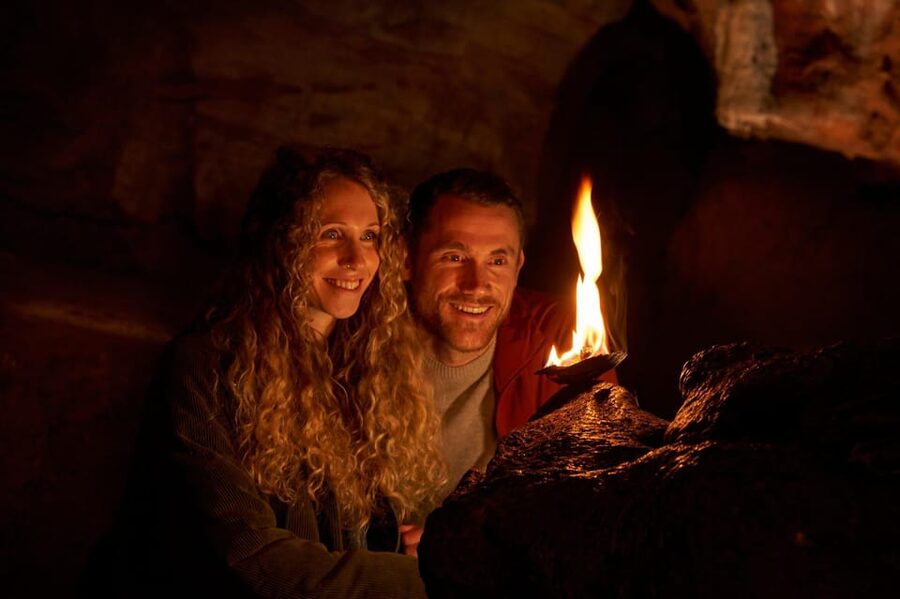
Many showcaves rely on dramatic formations alone. Kents Cavern has those in good measure, but its real strength is the link between the rock under your feet and the people who once used these chambers for shelter.
The cave formed over about 2.5 million years. Its rock is far older, dating back 400 million years, and the difference matters. Your guide can show you how the cave changed over immense stretches of time, then explain how later stalagmite floors sealed traces of Ice Age occupation below them.
That combination gives the tour a useful sense of scale. You are not simply looking at a stalactite and hearing a name for it. You are learning how water shaped the cave, how deposits formed floors, and how those floors helped preserve evidence of early humans and animals.
The cave was once a place of shelter, fire-making, tool shaping, and hunting. You will not see a preserved Stone Age settlement, but you will get a clear picture of why a cave like this mattered to people facing severe Ice Age weather.
More Cave Tours in the UK:
- Edinburgh: Underground Vaults Tour
★ 4.6 · 11,758 reviews - The World Famous Underground Ghost Tour
★ 4.5 · 9,272 reviews - Underground Vaults Walking Tour in Edinburgh Old Town
★ 4.5 · 8,506 reviews
The one-hour route through the cavern
All tours begin at the ticket desk, where staff direct you to the meeting point and explain the next step. The guided route starts in the Vestibule Chamber, the first major space inside the cave.
The temperature remains close to 14°C. That is cool enough to notice, especially if you arrive in summer, but not so cold that you need heavy outdoor clothing. A light jacket or warm jumper is the practical choice.
The route uses mostly flat concrete surfaces, with plenty of headroom. You will not need to stoop for most of the walk, which makes the cave easier to manage than many historic underground sites. There are nine shallow steps, some steep gradients of about 1:4 to 1:5, and a few narrow sections.
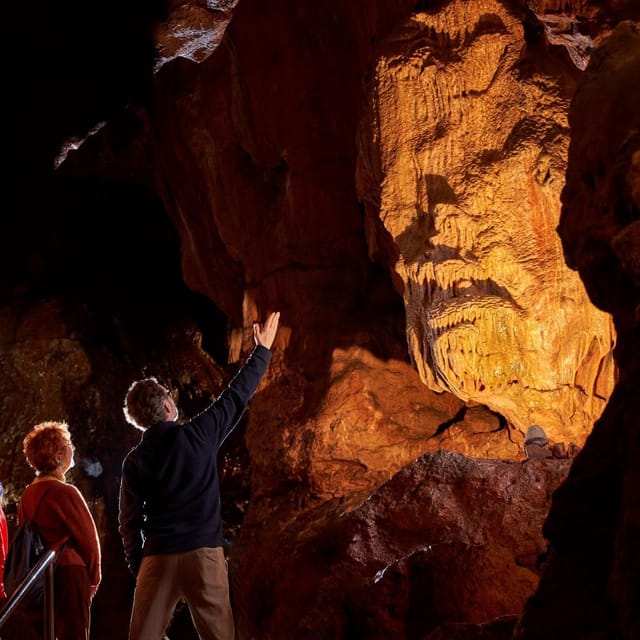
As you move from chamber to chamber, the guide explains the cave’s formation and points out the stalagmites and stalactites. The formations are the visual highlight, but the explanations give them meaning. Stalactites grow down from the ceiling, while stalagmites build up from the floor. Here, those deposits also helped close off older layers beneath them.
The hour passes quickly. That is good if you have children or a busy day in Torquay, but it also means the tour does not allow much time for lingering. Keep your attention on the guide, since the important detail is often in the explanation rather than in the largest formation in front of you.
The cave in darkness, and what fire meant
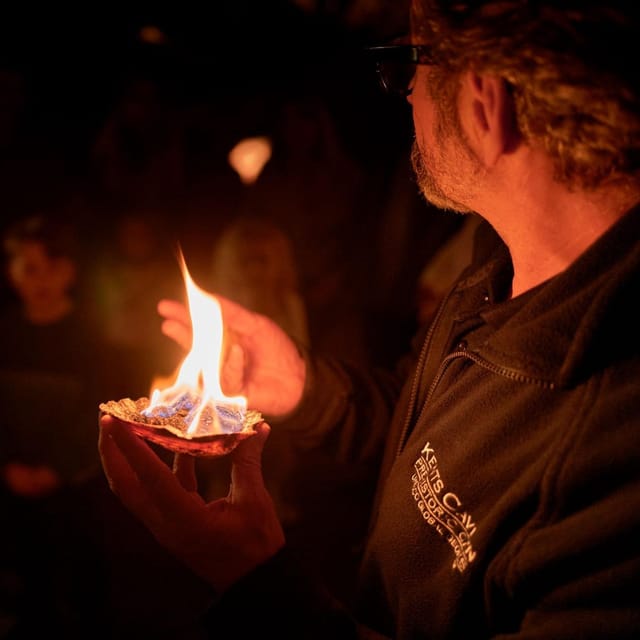
One of the most effective parts of the experience is the demonstration of light. Guide James has used shell candles made with wax and moss to show how early people could create a portable flame inside the cave.
The candles are small, yet they can throw enough light across a large chamber for you to see the people around you. When the electric lighting is removed, the difference is striking. Without a flame, the darkness is total. You cannot see your hand in front of your face.
That simple demonstration makes Stone Age life easier to understand. A fire was not only for cooking and warmth. It allowed people to move, work, and stay in a cave after sunset. The shell candle demonstration also shows why reliable light would have been a serious tool, not a minor convenience.
You should not expect a theatrical show with elaborate effects. The value comes from the brief change in conditions and the guide’s explanation. It turns an abstract lesson about prehistoric technology into something you can feel at once.
The Stone Age Zone and Britain’s earliest tools

After the cave walk, spend time in the Stone Age Zone. This area displays artefacts and bones linked to the people and animals associated with the cavern.
The collection includes some of the earliest tools found in Britain. That gives the visit a stronger purpose than a standard geology stop. You can connect the tools with the practical tasks discussed underground: cutting, working materials, making fires, and preparing food.
The bones help place the cave in the Ice Age world. Ancient animals once moved through the region, and the remains offer a glimpse of the creatures that shared this environment with early humans. The displays are especially useful if you want more context after seeing the cave itself.
For children, gemstone digging adds a hands-on activity. It is not a substitute for the archaeological displays, but it gives younger visitors something active to do and lets them take a small find home. Families should allow time for this rather than rushing straight from the guided tour to the exit.
Same stretch of coast and karst, a different entrance:
- Edinburgh: Haunted Underground Vaults and Graveyard Tour
★ 4.6 · 6,607 reviews - Edinburgh: Late-Night Underground Vaults Terror Tour
★ 4.6 · 4,162 reviews - Edinburgh: Evening Underground Ghost Tour
★ 4.4 · 3,092 reviews - Edinburgh: Multi-Sensory Haunted Underground Tour
★ 4.5 · 2,721 reviews
Victorian excavations and the work behind the discoveries
Kents Cavern was excavated during the Victorian era, and the tour explains how those early investigations shaped what we know about the site.
Victorian excavation methods were not the same as modern archaeological work. The important point for you is that evidence found in the cave did not simply appear on display. It was uncovered through years of digging, sorting, and interpretation.
The guide places the finds within that story, showing how the cave became important to the study of prehistoric Britain. This is one reason I would recommend paying close attention even if geology is not your main interest. The tour is about the process of discovering the past as much as it is about the cave’s appearance.
Guides vary, but the experience depends heavily on the person leading the group. James has been praised for mixing geological facts with humor, while Liv has handled a large group of around 38 people without losing the attention of different age groups. Charlie has also led tours that combine clear explanations with a strong sense of occasion.
That does not guarantee the same guide on your visit, but it does explain why the tour works best as a live presentation rather than a self-guided walk. You are hearing a human interpretation of the site, not just reading labels.
The Woodland Trail adds useful time outdoors
Your ticket includes the Woodland Trail, which gives you a change of pace after the underground route. The trail includes shelter building and Ice Age animal sculptures, with several chances for family photographs.
This outdoor section is modest, but it helps round out the visit. The cave tour asks you to focus on darkness, rock, and small details. The trail gives children room to move and turns prehistoric life into something more visual.
Shelter building also connects with the main theme of the visit. Early people needed protection from weather, and the activity gives children a simple way to think about how shelter works. The animal sculptures help younger visitors picture the creatures referred to during the cave tour.
I would treat the trail as an included extra rather than a reason to visit on its own. Its value is highest for families who want to spend more than an hour at the site.
How much value do you get for $22?
At $22 per person, this is a reasonable half-day-style stop if you use the included areas rather than counting only the one-hour cave walk.
The guided tour is the main product. You get an expert English-speaking guide, a structured route through the chambers, and explanations that would be hard to reproduce from a signboard. The Stone Age Zone, Woodland Trail, and gemstone digging add more value, especially for families.
The price is less attractive if you only want a quick look at cave formations. The tour lasts one hour, and the extra areas are not included as a separate major attraction. I would budget enough time to see them properly, visit the facilities, and stop at the Firestone Kitchen.
Food and drinks cost extra. The on-site café serves sweet items, lunch choices, and beverages, so you can rest after the tour without leaving the site. That makes the visit easier to fit into a day out, but it also means your final cost may be higher than the admission price alone.
Free cancellation up to 24 hours before the visit and reserve-now, pay-later booking make the ticket less risky when your Torquay plans are still changing.
Who will enjoy this, and who should think twice
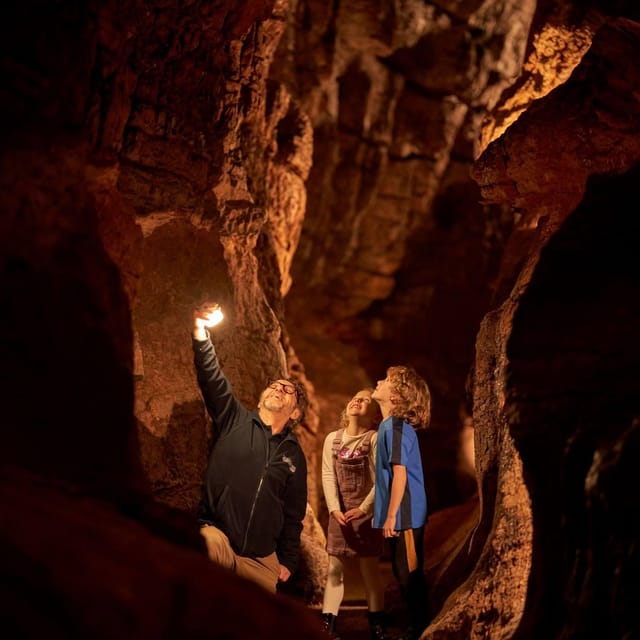
I would recommend Kents Cavern to families, history fans, geology enthusiasts, and anyone who likes attractions with a clear sense of place. Children have the gemstone digging and Woodland Trail, while adults get the archaeological and geological background.
It also works well for a rainy day. The cave route is sheltered, and the temperature remains fairly steady. Bring comfortable shoes, since the route includes slopes and steps, even though most of the surface is flat.
This is not the best choice for someone with claustrophobia. The chambers have headroom, but you are still underground, with narrow areas and limited space in parts of the route.
Wheelchair access is restricted. Wheelchairs cannot continue beyond the first chamber, though a film of the cave tour is available free in the visitor centre. Standard pushchairs can manage the cave footpath, but double and all-terrain pushchairs are too wide. Assistance dogs are allowed under their owners’ control.
The attraction requires at least two people for a tour to run. If you are visiting alone, call before booking so you can confirm arrangements.
Practical advice for a smoother visit
Wear sensible shoes with a secure sole. The concrete path is manageable, but the gradients and steps are easier with stable footwear.
Bring a warm layer and a camera. Photography is useful for the formations and woodland sculptures, but video recording is not allowed. Pets are not permitted, though assistance dogs can enter.
Keep the guide’s position in mind during the walk. Groups can be large, and one of the strongest parts of the experience is the commentary. Stay close enough to hear the explanation about the formations, excavations, and Stone Age evidence.
If you are visiting with children, explain that the cave tour itself is guided and paced as a group. Save the more active parts, such as gemstone digging and shelter building, for the Stone Age Zone and Woodland Trail.
Should you book Kents Cavern?
Book it if you want a compact, well-explained look at Britain’s prehistoric past, with enough family activity to keep the visit from feeling like a lecture. The cave formations are attractive, but the real appeal is the connection between geology, Ice Age animals, early tools, fire, and human shelter.
Skip it if you want a long, strenuous cave expedition or dislike enclosed spaces. The route is controlled, mostly flat, and designed for general visitors rather than serious caving.
For $22, I think the experience offers fair value when you use the Stone Age Zone and Woodland Trail as well as the one-hour tour. Choose comfortable shoes, bring a warm layer, and give yourself time for the darkness demonstration and the displays after the guide leads you back outside.
FAQ
How long does the Kents Cavern experience last?
The guided cave tour lasts one hour. Your ticket also includes the Stone Age Zone, Woodland Trail, gemstone digging, and access to site facilities, so you can spend additional time at the site.
What language is the tour in?
The live guided tour is in English.
Is Kents Cavern suitable for wheelchair users?
Wheelchairs cannot negotiate beyond the first chamber because of the gradients, steps, and narrow sections. A film of the cave tour is available free in the visitor centre.
Can I bring a pushchair?
Standard pushchairs can use the cave footpath. Double pushchairs and all-terrain pushchairs are too wide to access the caves.
What should I wear and bring?
Wear comfortable shoes and bring warm clothing because the cave remains at about 14°C. You may also bring a camera, but video recording is not allowed.
Are pets allowed inside Kents Cavern?
Pets are not allowed. Assistance dogs are welcome when under the control of their owners.
Just added around the UK
- Torquay: Guided Wildlife, Bushcraft, Sea Cave Kayak Safari★ 4.6 · 32 reviews
- London: Secrets of the London Underground Walking Tour★ 4.6 · 211 reviews
- London: Postal Museum Entry Ticket and Underground Rail Ride★ 4.6 · 363 reviews
- London: Jack the Ripper Tour and Underground Prison in Spanish★ 5.0 · 15 reviews
- Liverpool: The Beatles and Cavern Quarter Walking Tour★ 4.7 · 133 reviews
- Liverpool: City and Cavern Quarter Walking Tour★ 4.9 · 36 reviews
- Edinburgh: The Lost Close Underground Scotch Whisky Tasting★ 4.7 · 474 reviews
- Edinburgh: Underground Vaults and Graveyard Evening Tour★ 4.4 · 393 reviews
UK Cave Tours, compared.
Underground Vaults Walking Tour in Edinburgh Old Town
Read the review →
Haunted Underground Vaults and Graveyard Tour
Read the review →
Underground Vaults Evening Ghost Tour with Whisky
Read the review →
Browse the lists this tour appears in