
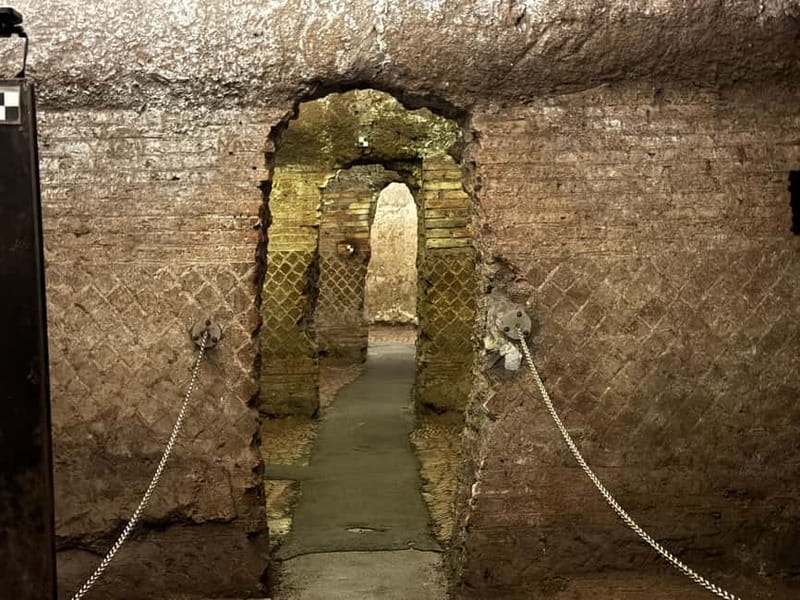
Review · ROME CAVE TOURS
Rome underground hidden temples, ruins, and secret basilicas
Rome keeps its best surprises below street level. This walk takes you from Michelangelo’s Moses and the chains said to have bound St. Peter to the ruins of an ancient gladiator school, then down through three buried layers at San Clemente. You are not simply looking at old stones. You are watching Rome build itself, bury itself, and build again.
I like two things here: the sites sit close to the Colosseum, so you can trade arena crowds for quieter streets without losing much time, and the San Clemente visit gives you a clear journey through Roman, early Christian, and medieval history. The main drawback is practical: stairs, uneven floors, and church dress rules make this unsuitable for wheelchair users and anyone carrying bulky luggage.
Key points to know
- San Clemente goes three levels underground: You move from the 12th-century basilica to a 4th-century church, then to a 1st-century Roman house and Mithraeum.
- Michelangelo’s Moses is an early stop: The sculpture and St. Peter’s chains are inside San Pietro in Vincoli.
- The Ludus Magnus connects to gladiator history: You see the training-ground ruins near the Colosseum, though the visit is outdoors and brief.
- You choose your level of help: The private guided option covers all three main stops, while the audio option focuses on San Clemente.
- The walking is short but the underground sections are not easy: Wear sturdy shoes, cover your knees and shoulders, and leave large bags behind.
- The price is $31 per person: That is reasonable for the self-guided San Clemente visit, and especially good value if you want a private guide for the full route.
Why Rome’s underground layers are worth your time
Rome’s famous monuments can feel like a greatest-hits tour: the Colosseum, Roman Forum, Pantheon, and Trevi Fountain. Those places matter, but they also come with crowds and a lot of visual noise. This experience offers a smaller-scale way to understand how the city changed over 2,000 years.
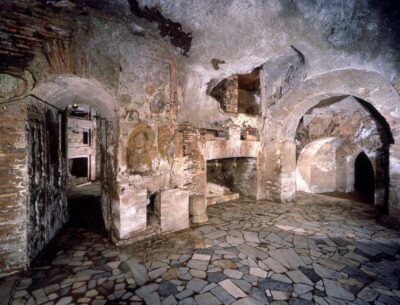
The strongest part is San Clemente. You can stand in the present-day church, go downstairs, and find an earlier church beneath it. Go lower and you reach a Roman house and a temple connected with the cult of Mithras. Few places explain Rome’s past so physically. The dates are not just printed on a sign. The building itself gives you the sequence.
That makes this a good companion to a Colosseum visit. At the arena, you see Rome’s public spectacle. Here, you see private worship, domestic life, and the religious changes that took place under the same streets.
The tour lasts from about one to two and a half hours, depending on the option and timing. That range matters. The audio visit can suit a short morning or afternoon gap, while the private route gives each stop more explanation and includes San Pietro in Vincoli and the Ludus Magnus.
More Cave Tours in Rome:
- Colosseum: Underground and Ancient Rome Tour
★ 4.7 · 12,691 reviews - Rome: Capuchin Crypts and Catacombs Tour with Transfers
★ 4.6 · 6,456 reviews - Expert Guided Tour of Colosseum Arena OR Underground, and Forum
★ 4.5 · 5,041 reviews
Starting near San Pietro in Vincoli
The meeting point may be Via Labicana 96 or Piazza di San Pietro in Vincoli, depending on the option you book. Check the confirmation carefully. The two choices are close to the Colosseum area, but you do not want to begin by guessing which street to use.
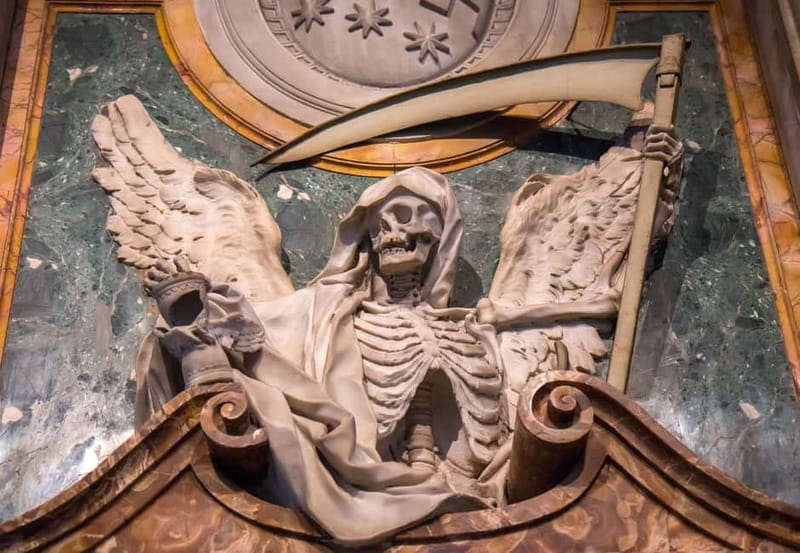
San Pietro in Vincoli sits in a quieter piazza reached by a short walk. The church is best known for two unusual treasures. One is a set of chains associated with St. Peter. The other is Michelangelo’s Moses, a powerful sculpture with careful detail in the face, beard, hands, and clothing.
The stop is listed at about 20 minutes. That is enough to see the main works with a guide, but it is not a long art-history lecture. If Moses is a major reason you are booking, give yourself a little patience as you enter, find the correct chapel, and adjust to the darker interior.
This opening stop also sets the tone. You begin with a church that is still an active place of worship, not a museum built solely for sightseeing. Dress respectfully from the start. Knees and shoulders must be covered for both men and women, and the rule is strictly enforced.
The Ludus Magnus and Rome’s gladiator machine
From the church, the route continues on foot to the Ludus Magnus. This was the training complex associated with the Colosseum, where gladiators prepared for combat and lived close to the arena.
The remains are viewed during a short guided stop of about 15 minutes. Do not expect a full underground tour here. The value is in the connection: you are looking at the training ground near the arena and learning how the fighters’ world fitted into the larger Roman entertainment system.
The location also helps you read the Colosseum area differently. The amphitheater was not an isolated building. It needed training facilities, access routes, workers, performers, and a steady supply of people and animals. The Ludus Magnus ruins give you one piece of that system.
The stop is brief, so this part will suit you best if you enjoy context and storytelling rather than long time at each ruin. If you want extended access to the Colosseum itself, this experience does not replace a Colosseum ticket or Forum visit. It adds a nearby site that many itineraries skip.
San Clemente’s three underground levels
San Clemente is the main event. The basilica is close to the Colosseum, but its importance comes from what lies below the decorated upper church.
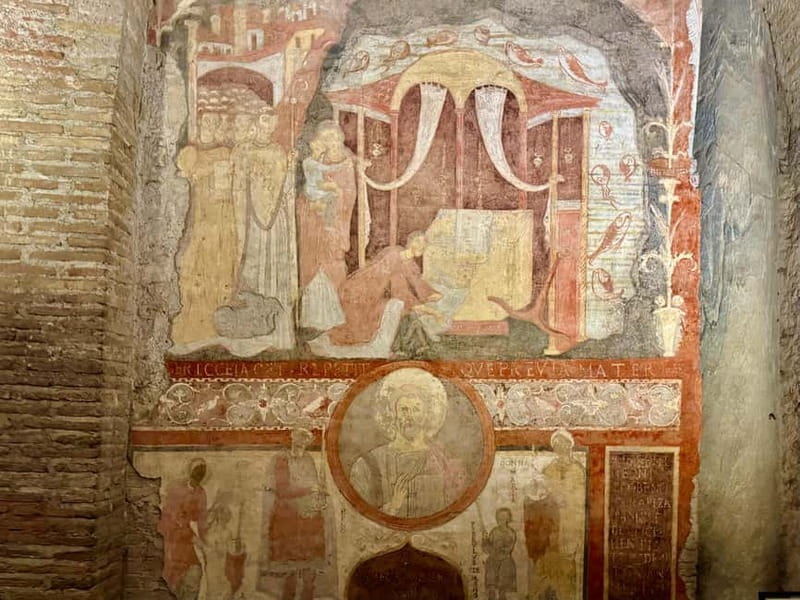
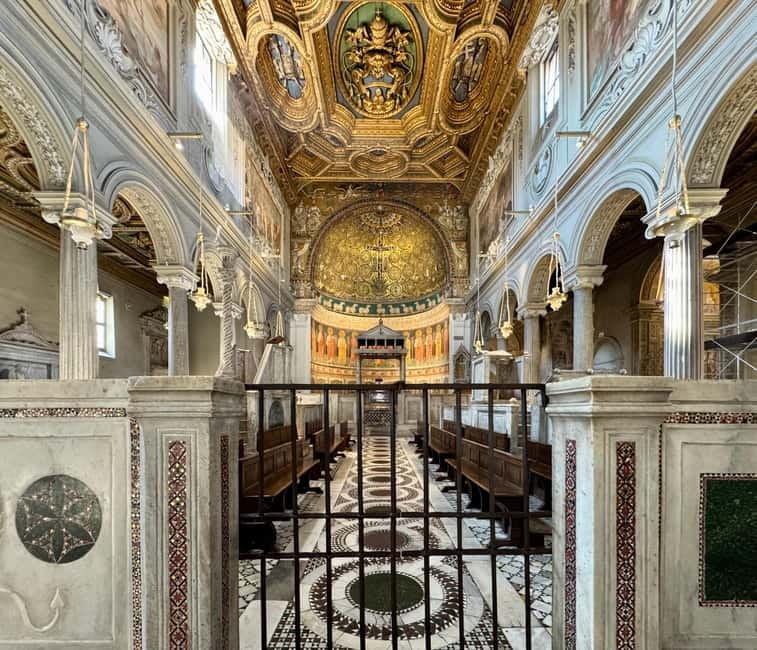
The current basilica dates to the 12th century. Look for its mosaics and the visual richness of the interior before heading downstairs. This upper level is the most familiar form of church space in the tour: a functioning religious building with art, ceremony, and centuries of use.
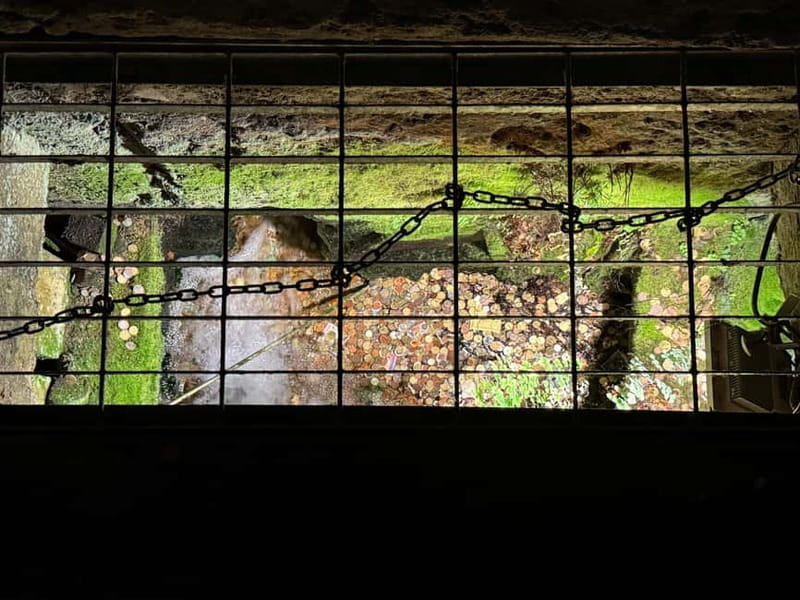
Below it is a 4th-century church. The earlier building is more austere, and its buried position makes the passage through time easy to understand. The later church was constructed above it, preserving the older structure underground rather than erasing it completely.
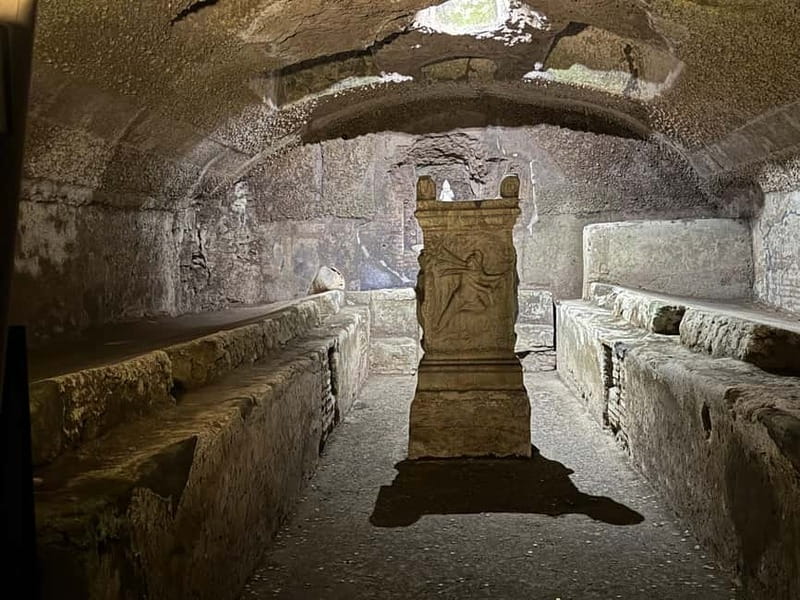
The lowest level reaches a 1st-century Roman house and a Mithraeum. Mithras was a pagan deity worshipped in private cult settings, and the temple here points to a religious world that existed before Christianity became dominant in Rome. The setting is intimate and atmospheric, with the remains giving you a sense of worship taking place away from the city’s public monuments.
This is the section where the tour earns its price. You are not only hearing that Rome changed religions and rebuilt over old foundations. You are moving through the physical evidence of those changes.
The visit to San Clemente is listed at about 45 minutes. That is enough to see the three levels without turning the stop into an all-day study session. The floors can be uneven, and the stairways require care. Take your time going down and back up, especially if you have spent the day walking across Rome.
Same stretch of coast and karst, a different entrance:
- The Original Roman Crypts and Catacombs Tour with Transfers
★ 4.5 · 4,896 reviews - Rome: Colosseum Underground Small Group Guided Tour
★ 4.7 · 4,844 reviews - Rome: St. Peter’s Basilica, Dome Climb, and Underground Tour
★ 4.8 · 3,404 reviews - Rome: Colosseum Underground, Arena & Forum Tour
★ 4.7 · 3,272 reviews
Private guide or audio tour?
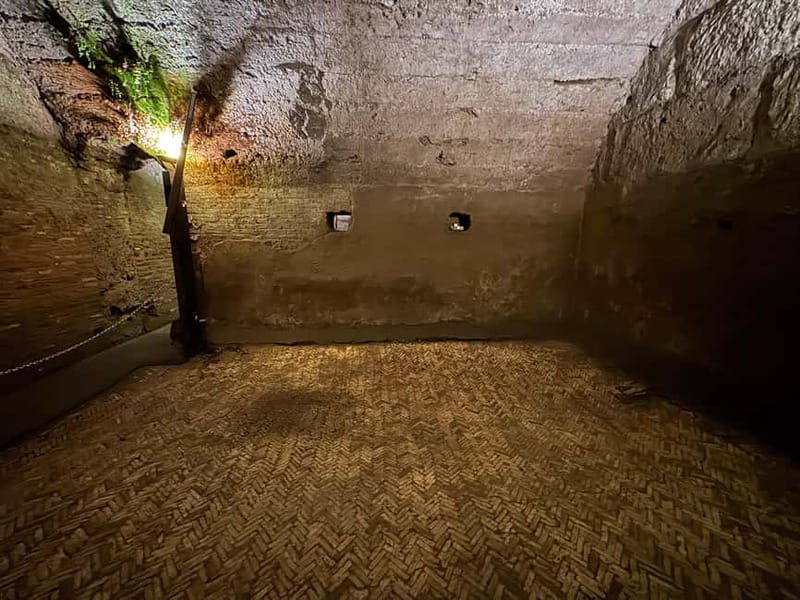
The private guided tour is the fuller choice. It includes San Pietro in Vincoli, the Ludus Magnus, and all three underground levels of San Clemente. A private group can ask questions and move at a pace that fits its interests, which is useful when one person wants more art detail and another wants Roman archaeology.
The private guide is listed as English, while the activity information also lists live guiding in English, Spanish, Italian, and French. Confirm your preferred language when booking. The supplied information does not name individual guides, so you should not book expecting a particular person.
The audio option is narrower but more flexible. It includes entry to San Clemente and access to the three underground levels, allowing you to set your own pace. Audio is available in English, Italian, Spanish, French, and German.
I would choose the audio option if you already know the Colosseum area, dislike fixed pacing, or want a focused visit to San Clemente. It is also a practical way to keep the cost down while still getting context inside the basilica.
Bring your own headphones. You will need a smartphone made in 2020 or later with a current operating system for the best app performance. Older devices may have trouble with compatibility or playback. A low battery or weak phone is a poor partner for a self-guided visit, so charge up before you leave.
Is $31 good value?
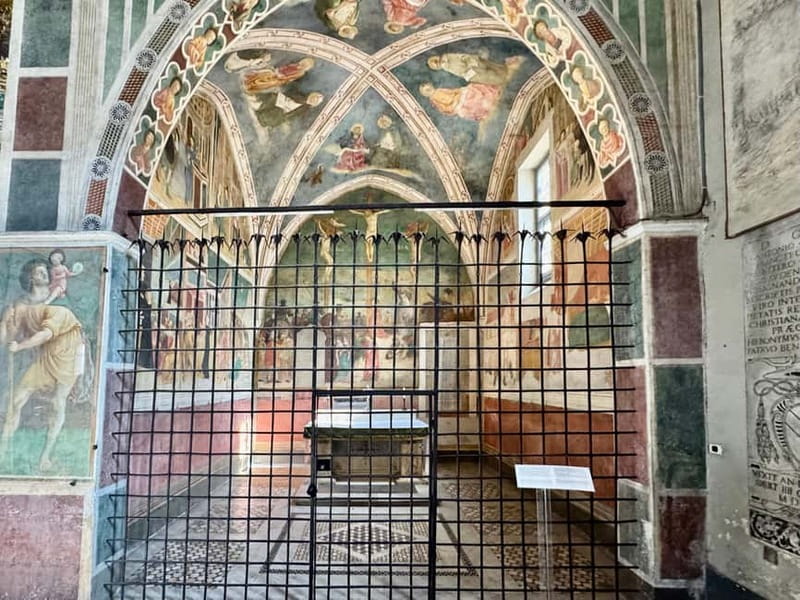
At $31 per person, the value depends on the version you choose. For the audio visit, you are paying for entry to San Clemente’s three underground levels plus the app. That is a fair price if you want a short, independent archaeological stop near the Colosseum.
The private guided option offers more for the same general outing because it adds San Pietro in Vincoli and the Ludus Magnus, along with a live guide. A private group usually costs more than a basic entry ticket, but the personal explanation helps connect three very different sites.
The experience is also efficient. There is no transportation between stops because the route is walkable. You avoid the time and cost of a taxi, although you should not read walkable as effortless. Rome’s streets, stairs, and uneven surfaces can be tiring after a full day of sightseeing.
The tour includes entrance tickets for the guided option and San Clemente entry for the audio option. Food, drinks, hotel pickup, and drop-off are not included. Plan this as a compact cultural outing, not a meal stop or city transfer.
Who will enjoy this underground route?
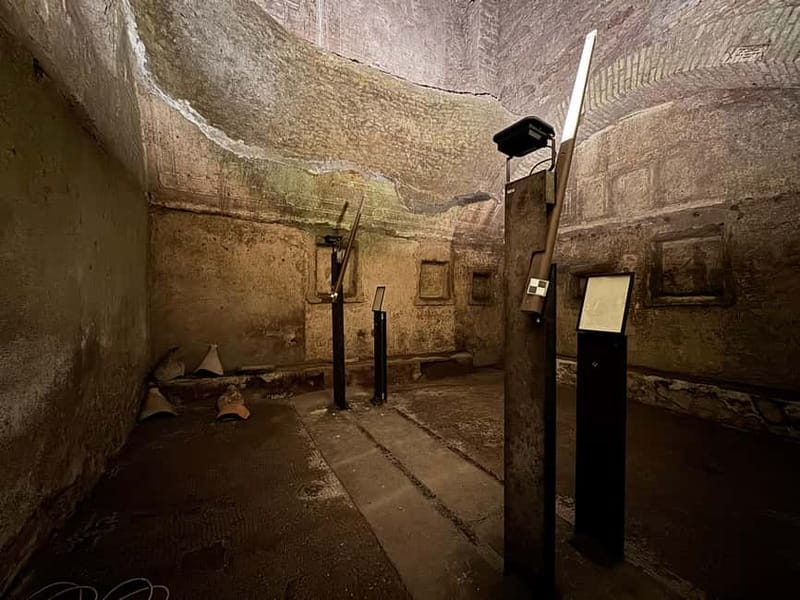
I recommend the private version for first-time Rome visitors who want a guide to explain how the sites connect. It also suits families with older children who are curious about gladiators, ancient temples, and underground passages, provided everyone can manage the stairs.
History-minded visitors will get the most from San Clemente. The appeal is not one spectacular object alone. It is the sequence of buildings and beliefs, each one surviving below the next.
The audio option suits independent visitors, repeat visitors, and anyone looking for something different from the usual Roman sights. One verified booking note praised the phone audio and described the underground area as larger than expected, which fits the main strength of this choice: you can take in a substantial site without committing to a full-day tour.
This is not a good fit for wheelchair users. Non-folding wheelchairs, walking frames, and electric wheelchairs are not allowed, and the underground areas include stairs and uneven surfaces. Large bags and luggage are also not allowed, so store them before you arrive.
Practical advice for a smoother visit
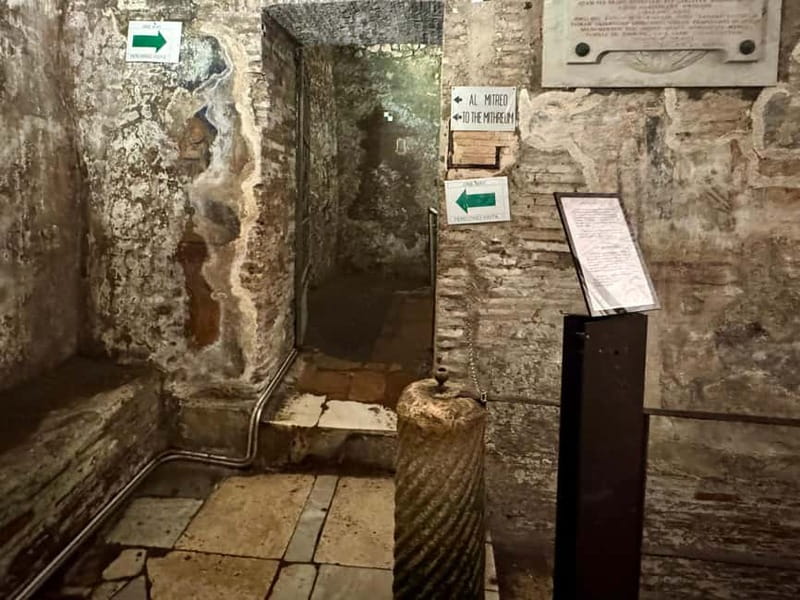
Wear comfortable shoes with a firm sole. You will walk between the sites and use stairs underground. Rome’s heat can be strong outside, while underground areas may feel cooler, so dress in layers if needed.
Cover your knees and shoulders before entering either church. This applies to men and women, and entry can be refused if you do not meet the dress code. Smart casual clothing is required.
Allow extra time to find the meeting point. The tour may begin at Via Labicana 96 or Piazza di San Pietro in Vincoli, and the precise location depends on the option booked. The activity operates in all weather, so carry suitable protection for rain or heat.
The route finishes at Piazza di San Clemente. That is useful for planning the rest of your day, but remember that no return transportation is provided. You will need to make your own way onward.
Free cancellation is available up to 24 hours before the experience for a full refund, and you can reserve now and pay later. Those terms help if your Rome schedule is still shifting, but the more important booking decision is choosing guided or audio.
Should you book it?
Book this experience if you want Rome beyond the grand postcard sites. The private tour is the better buy for a first visit because it combines Moses, the gladiator school, and San Clemente in one compact walk. It gives you a clear story and removes the guesswork from the underground visit.
Choose the audio version if your priority is flexibility and San Clemente itself. Skip it if stairs are difficult, you need wheelchair access, or you are already overloaded with church interiors and ancient ruins.
For most able walkers, this is a smart $31 addition near the Colosseum. It is short enough to fit into a busy Rome day, yet substantial enough to change how you see the city above your feet.
FAQ
How long does the underground Rome experience last?
The duration is listed as one to two and a half hours. The exact length depends on the option booked and the available start time.
What sites are included in the private guided tour?
The private guided route includes San Pietro in Vincoli, Michelangelo’s Moses, the chains associated with St. Peter, the Ludus Magnus ruins, and all three underground levels of San Clemente.
What does the audio-guided option include?
The audio option includes entry to the Basilica of San Clemente and access to its three underground levels. It does not include the private visits to San Pietro in Vincoli or the Ludus Magnus.
Which languages are available?
The private guide is described as English, with live guiding also listed in Spanish, Italian, and French. The audio guide is available in English, Italian, Spanish, French, and German. Confirm the language for the guided option when booking.
Do I need to bring my own phone and headphones?
Yes. The audio tour uses an app, and a smartphone made in 2020 or later with the latest operating system is recommended. Bring your own headphones for the best audio quality.
Is the experience wheelchair accessible?
No. The underground areas contain stairs and uneven surfaces, and the experience is not suitable for wheelchair users. Walking frames and electric wheelchairs are also not allowed.
What should I wear and bring?
Wear comfortable walking shoes and bring a passport or ID card. Knees and shoulders must be covered inside the churches, and large bags, luggage, pets, and smoking are not allowed.
Just added around Rome
- St. Peter’s Basilica and Vatican Grottoes Tour★ 4.9 · 120 reviews
- St. Peter’s Basilica Full Guided Tour with Vatican Grottoes★ 4.6 · 286 reviews
- Rome: St Peter’s Basilica Express Tour & Grottoes★ 4.3 · 126 reviews
- Rome: Tour of St. Clement’s Basilica Underground Temples★ 4.8 · 242 reviews
- Rome: Underground Trastevere Guided Walking Tour★ 4.8 · 87 reviews
- Rome: Appian Way, Aqueducts, & Catacombs E-Bike Guided Tour★ 4.9 · 54 reviews
- Rome: Trevi Fountain District Underground Tour and Ice Cream★ 4.5 · 356 reviews
- Rome: Trevi Fountain Underground Small Group Tour★ 4.4 · 47 reviews
Rome Cave Tours, compared.
Colosseum: Underground and Ancient Rome Tour
Read the review →
Capuchin Crypts and Catacombs Tour with Transfers
Read the review →
Expert Guided Tour of Colosseum Arena OR Underground, and Forum
Read the review →
The Original Roman Crypts and Catacombs Tour with Transfers
Read the review →
Colosseum Underground Small Group Guided Tour
Read the review →
St. Peter’s Basilica, Dome Climb, and Underground Tour
Read the review →
Catacombs of St. Callixtus Entry Ticket & Guided Tour
Read the review →Browse the lists this tour appears in