Review · CATACOMBS & UNDERGROUND CITY TOURS
Rome: Appian Way, Catacombs, & Roman Aqueducts E-bike Tour
Rome’s most memorable ancient sights are not all inside the city center. This e-bike ride takes you from the Aurelian Walls along the 2,300-year-old Appian Way, past Roman tombs and villas, then out to the giant arches of the Aqueducts Park. It is part history lesson, part countryside ride, and part practical escape from Rome’s crowds.
I especially like the route’s mix of ancient ruins and open green space, and the strong Cannondale e-bikes make the 27-kilometer distance manageable. The main caution is simple: this is not a gentle city cruise. You will ride gravel, uneven ground, and some traffic-filled streets, so basic bike confidence matters.
Key points to know
- The six-hour option adds the Catacombs: You get a guided underground visit at St. Callixtus or St. Sebastian, while the four-hour version only pauses at the entrance.
- Most of the route is away from traffic: About 60 percent runs through parks and off-road areas, including the Appian Way, Aqueducts Park, and Caffarella Valley.
- The city sections require attention: Around 40 percent of the ride uses carefully selected urban streets, with guides managing crossings and group movement.
- The bikes do the heavy work: Cannondale e-mountain bikes with electric assistance and anti-puncture tires handle the long distance and hills well.
- The group stays small: A maximum of 10 people gives the guide a realistic chance to help with traffic, pacing, and bike questions.
- Children can join, with limits: Infants from ages 1 to 4 use a child seat, ages 5 to 8 use a child extension, and children 9 and older can ride an e-bike independently.
Why the Appian Way is worth a half-day

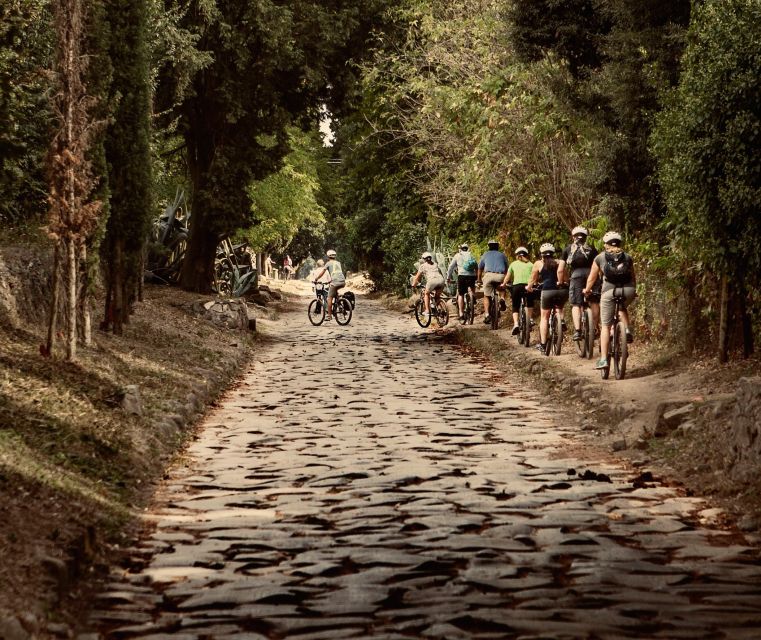
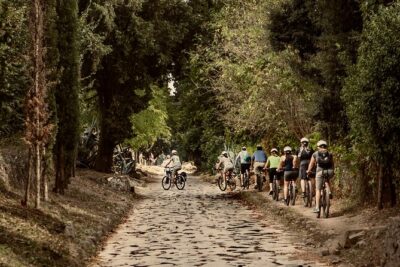
The Appian Way is one of Rome’s best places to understand the city beyond its famous center. Built in 312 BC, this ancient road once connected Rome with southern Italy. Today, sections of the old route pass through a protected area where stone paving, grass, umbrella pines, tombs, and country lanes sit side by side.
On foot, the distances between sights can be tiring. By e-bike, you can cover far more ground without turning the day into an endurance test. The electric assistance is especially useful on the rougher sections and gradual climbs, but you still need to steer and balance over gravel and stones.
The route also gives you a different view of Rome’s past. Instead of seeing one monument in isolation, you follow the road that linked them. Tombs line the route because Roman law prohibited burials inside the city. Villas and mausoleums show how wealthy families used the area, while the road itself tells the larger story of Rome’s power and expansion.
The setting is often quiet, but do not expect a perfectly smooth bike path. Parts of the ancient road are bumpy. A few riders have found the terrain more demanding than expected, especially those who do not often ride off-road. Comfortable shoes and a relaxed grip on the handlebars will help.
More Catacombs and Underground City Tours in Italy
- Rome: Capuchin Crypts and Catacombs Tour with Transfers
★ 4.6 · 6,456 reviews - The Original Roman Crypts and Catacombs Tour with Transfers
★ 4.5 · 4,896 reviews - Rome: Catacombs of St. Callixtus Entry Ticket & Guided Tour
★ 4.6 · 3,037 reviews
Meeting at Via Labicana 49
The ride begins at Via Labicana 49, within easy walking distance of two Metro stations. From Colosseo station, allow about 10 to 15 minutes. Walk past the Colosseum as Via Labicana continues, then look for number 49 on the right.
From Manzoni station, the walk takes about 10 minutes. Follow Viale Manzoni toward the Colosseum, then continue as the street becomes Via Labicana. Number 49 is on the left.
This starting point is useful because it places you near the Colosseum without making you cross the entire city before the ride begins. Arrive with enough time to get fitted for your helmet, adjust the bike, and learn how the electric assistance works.
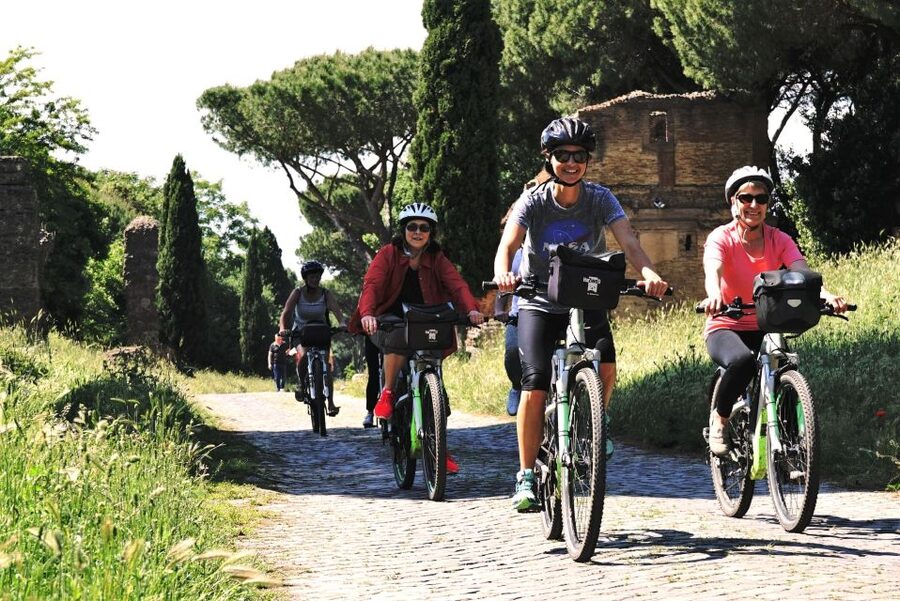
The equipment includes a Cannondale quality e-mountain bike, helmet, five-liter handlebar bag, and biodegradable bottle of water. Helmet use is mandatory. The bikes have anti-puncture tires, and the electric system makes a major difference on a route of this length.
If this is your first e-bike ride, tell the guide right away. Guides such as Ximena, Bita, and Arina have helped first-time riders understand the gears and electric assistance before heading into traffic. You should still be comfortable balancing and braking before joining the group.
Through the Aurelian Walls and toward the ancient road
The first landmark is the Aurelian Walls, the great defensive ring built around Rome in the third century AD. Passing through this fortified boundary gives the ride a clear sense of transition. You leave the dense modern center and begin following the old route into a more open part of Rome.
The guide explains how the walls protected the growing city and how the Appian Way connected Rome to the wider Roman world. This is also where the ride begins to require concentration. Urban streets connect the center with the parks, and traffic cannot be removed from the equation.
The guide rides at the front and keeps the group together. Several guides, including Oscar, Anna, and Arina, have been praised for careful road positioning and clear warnings before busy sections. That matters because the most stressful part of the experience is not the countryside. It is the short urban links between major sites.
You will not spend the whole tour in traffic. About 40 percent of the route is in the city, while the other 60 percent runs through parks and off-road areas. Still, you should be comfortable riding in a group and following instructions at crossings.
The Catacombs: choose four hours or six
The tour comes in two versions, and the difference is important. The four-hour tour does not include an underground catacomb visit. It makes a short stop at the entrance, usually about five minutes, while the guide explains the site’s role in early Christian history.
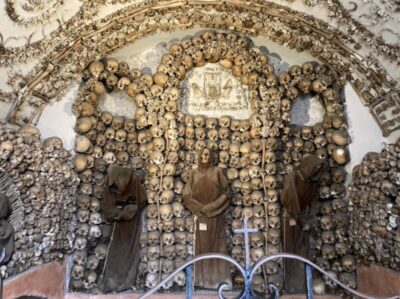
The six-hour tour includes a guided visit inside the Catacombs of St. Callixtus or St. Sebastian. You go below ground into the crypts and corridors, where the atmosphere changes sharply from the open countryside. This is the better choice if you want a fuller history experience and do not mind committing most of the day.
The catacombs add depth to the tour because the Appian Way is not only about roads, monuments, and engineering. It also reflects the early Christian communities that lived and worshipped on the edge of ancient Rome. The underground visit brings that part of the story into focus.
If your Rome schedule is tight, the four-hour version still gives you the main ride and the outdoor archaeological sites. If you are choosing this tour mainly for the catacombs, book the six-hour option and check the exact version carefully before paying.
More Catacombs and Underground City Tours in Rome
- Rome: Guided Roman Catacombs Tour with Transfers
★ 4.6 · 1,830 reviews - Rome: Catacombs Guided Tour with Transfer
★ 4.2 · 1,808 reviews - Rome EBike Tour: Appian Way, Catacombs & Roman Aqueducts
★ 5.0 · 1,766 reviews - Rome: Catacombs and Capuchin Crypt Guided Tour with Transfer
★ 4.6 · 1,606 reviews
Roman tombs, villas, and the Circus of Maxentius
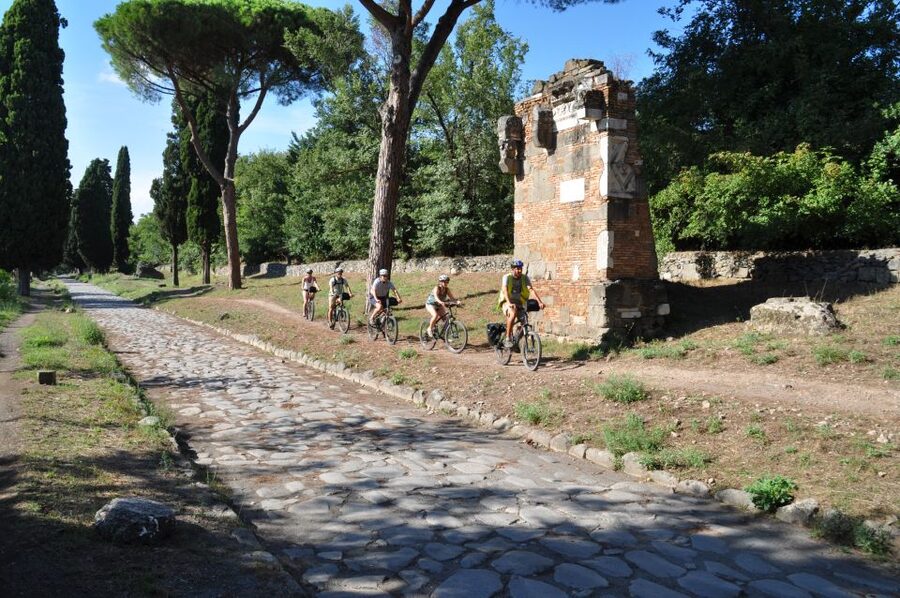
Once you are on the Appian Way, the route becomes more scenic and less pressured. You pass ancient tombs, mausoleums, and the remains of large villas built for Rome’s wealthy families. The guide pauses at several points so you can hear the story and take photographs.
The Circus of Maxentius is one of the route’s striking stops. Built under the emperor Maxentius, it was part of a large imperial complex. The remains help show how much activity once took place beyond Rome’s central monuments.
The Tomb of Cecilia Metella is another major landmark. Its round tower-like form is easy to recognize, and its position beside the Appian Way makes clear how prominent families used monumental tombs to display status. This is one of the places where the bike route feels especially useful. You can approach the ancient road, stop, listen, and continue without retracing a long walking route.
The Villa dei Quintili adds another layer. This sprawling estate belonged to two wealthy brothers before the emperor Commodus took it over. From the bike, you get a sense of the property’s scale rather than only seeing a single ruined wall.
The guide does not simply point at each ruin and move on. The best guides, including Pablo, Ali, and Cas, connect the stops to larger themes such as Roman wealth, imperial power, roads, burial customs, and the gradual decline of the ancient city. The amount of detail can vary by guide, but the format allows for questions and conversation.
Aqueducts Park and Rome’s engineering skill
The Aqueducts Park is the visual high point of the ride. Long rows of arches cross the open park, sometimes standing alone against the sky and sometimes running in parallel lines. The scale is difficult to grasp from a photograph. Cycling beside the structures gives you time to see how far they extend.
These aqueducts carried water into Rome from springs and reservoirs far outside the city. Their design relied on a carefully controlled gradient, allowing water to flow over long distances without pumps. The guide explains how the system supported public fountains, baths, homes, and monumental building projects.
This is a good place to appreciate the value of a small group. The guide can stop the bikes, gather everyone near the arches, and explain the engineering without shouting over a large crowd. You also get time for photographs instead of being hurried from one viewpoint to the next.
The ride then follows the aqueducts back toward modern Rome. This section combines broad views, dirt paths, and stretches of easy riding. It feels far removed from the Colosseum, yet the ancient water system points directly back to the city’s growth.
One practical note: the aqueduct paths are not always smooth. The route is classified as intermediate, with about 17 miles in total and 60 percent off-road. The e-bike reduces the effort, but it does not erase bumps, loose surfaces, or the need to steer carefully.
Caffarella Valley and the final return
After the Aqueducts Park, the route crosses the green Caffarella Valley. This open area is another reason to choose the bike tour instead of staying within central Rome. You get a broad, rural-feeling stretch without traveling far from the city.
Caffarella also helps break up the historical stops. After tombs, catacombs, and aqueducts, the quiet paths give you space to simply ride. The pace is generally steady, with pauses for explanations and photographs rather than a race from one sight to the next.
The final return passes near the Baths of Caracalla before heading back toward Via Labicana 49. The baths were among ancient Rome’s grandest public bathing complexes, and their scale makes a fitting last reminder of the city’s engineering and public life.
The exact timing can shift. On Wednesdays, the tour may run about 30 minutes longer. A six-hour outing can also include a food stop along the way, but food and drinks are not included. You can purchase something on the route, and some guides have stopped at a local pizzeria for lunch.
How hard is the 27-kilometer ride?
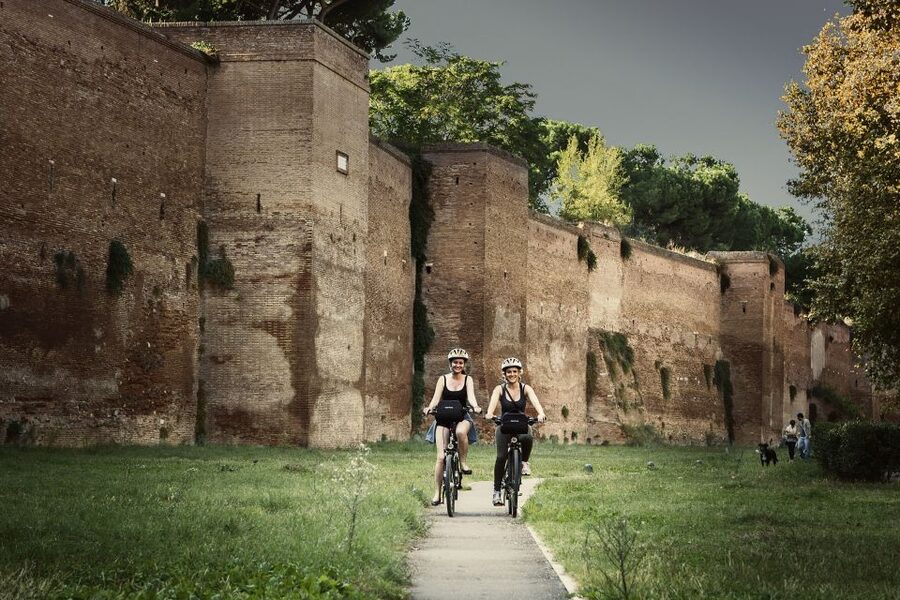
The electric assistance makes the distance approachable for many people, including riders who are not highly fit. Several riders have found that hills and the full six-hour route felt manageable because the bikes supplied steady power.
That does not make this a beginner cycling lesson. You need to know how to start, stop, turn, and handle a bike on uneven ground. One useful piece of advice is to try an e-bike somewhere quiet before the tour if you have never used one. The busy streets near the start are not the ideal place to learn from scratch.
The rough sections can be bumpy. One rider wished for rear suspension, while another found the ride perfectly manageable despite limited off-road experience. Those two reactions point to the right expectation: the route is accessible, but it is not polished pavement from beginning to end.
The tour is difficult with a child seat or child extension, according to the operator. Infants ages 1 to 4 can ride in a child seat up to 22 kilograms, free of charge. Children ages 5 to 8 use a child extension, and children 9 and older can ride an e-bike independently. The equipment has a maximum rider weight of 136 kilograms.
Guides, group size, and safety
The group is limited to 10 people, with at least four participants required for the tour to operate. A small group makes a real difference here because the guide has to manage both archaeology stops and road crossings.
Guides have included Oscar, Arina, Agnese, Bita, Pablo, Ali, Cas, Ximena, and others. The strongest part of the guiding style is the combination of history and road management. Guides explain what you are seeing, keep the pace reasonable, and warn you before the more demanding traffic sections.
Do not expect a silent ride. You will spend much of the day listening to explanations, asking questions, and moving as a group. At the same time, the route includes enough open riding that you are not standing beside a monument for hours.
Safety equipment includes a helmet, and helmet use is required. The bikes are sturdy, but you should check your saddle position, brakes, gears, and electric assistance before leaving. Speak up if something feels wrong. A guide can fix a small issue more easily at the start than halfway across the park.
Is $85 a good value?
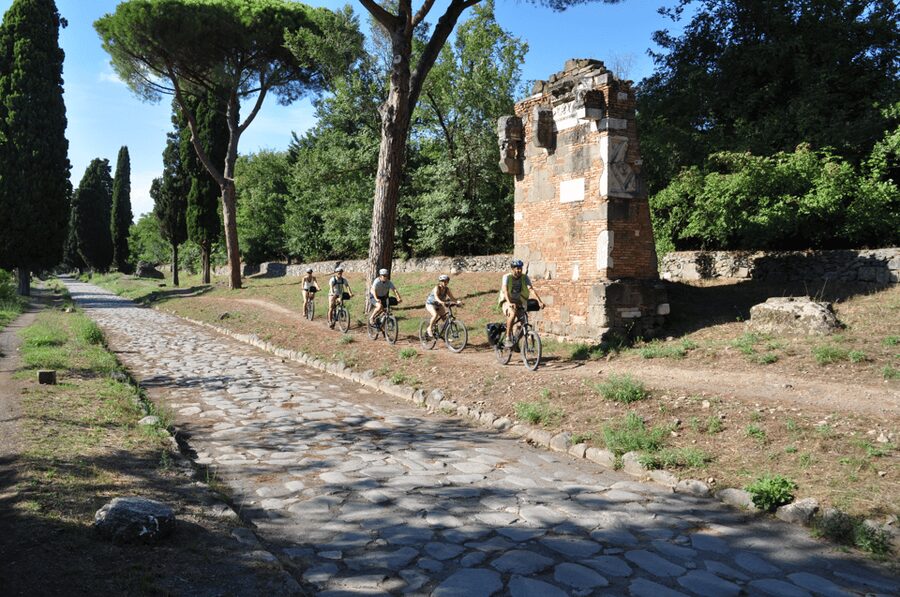
At $85 per person, this is a good value if you want several experiences in one outing. You are paying for a quality e-mountain bike, helmet, water, guide, route planning, traffic support, and access to a part of Rome that is awkward to cover independently in a single day.
The six-hour option offers the strongest value because it adds the guided catacomb visit. The four-hour version may suit you better if you want the ride but need to protect the rest of your day. Food and drinks cost extra, so bring some money or plan to buy something along the way.
A self-guided bike rental could cost less, but it would not provide the same route knowledge or support on Rome’s streets. You would also need to plan how to connect the Appian Way, the Aqueducts Park, Caffarella Valley, and the Baths of Caracalla.
The price makes less sense if you dislike cycling, have trouble on gravel, or want a slow walking tour with long indoor visits. This is an active sightseeing day, not a vehicle-based tour with a few short walks.
Who should book this e-bike tour?
I would choose it for anyone who has already seen the Colosseum and Roman Forum and wants a different side of the city. It is also a strong pick for families with older children, couples, and visitors who enjoy combining history with time outdoors.
Teenagers often respond well to the mix of e-bikes, ruins, and dirt paths. Families with children ages 9 and older can let them ride independently if they have the required bike skills. Younger children can join with the stated attachments, but the intermediate route still deserves careful thought.
You should be comfortable with a 27-kilometer day, city traffic, gravel, and uneven ground. If you are a confident cyclist but not an athlete, the electric assistance should make the distance reasonable. If you rarely ride a bike, practice first or choose a less demanding activity.
Book the six-hour version if the catacombs are a priority and you want the fullest historical program. Choose four hours if the Appian Way and aqueducts are your main goals and you prefer a shorter outing.
FAQ
How long is the Appian Way e-bike tour?
You can choose a four-hour or six-hour version. The six-hour option includes the guided catacomb visit.
Does the tour visit the catacombs?
The six-hour tour includes a guided visit to the Catacombs of St. Callixtus or St. Sebastian. The four-hour tour stops briefly at the entrance for an explanation but does not include the underground visit.
How far do you ride?
The route is about 27 kilometers, or 17 miles. Around 60 percent is off-road, and about 40 percent uses city streets.
Is the tour suitable for children?
Infants ages 1 to 4 can use a child seat up to 22 kilograms. Children ages 5 to 8 use a child extension, and children ages 9 and older can ride an e-bike independently. The route is considered intermediate and difficult with a child seat or extension.
What is included in the price?
The tour includes a Cannondale e-mountain bike with anti-puncture tires, a helmet, a five-liter handlebar bag, a biodegradable bottle of water, and a professional guide. The guided catacomb visit is included only with the six-hour tour. Food and drinks are not included.
Where does the tour start?
The meeting point is Via Labicana 49. It is about 10 to 15 minutes on foot from Metro Colosseo and about 10 minutes from Metro Manzoni.
Should you book it?
Book this tour if you want Rome’s ancient past with room to breathe. The Appian Way, Circus of Maxentius, Tomb of Cecilia Metella, Villa dei Quintili, Aqueducts Park, and Caffarella Valley create a varied day that central Rome cannot provide.
The six-hour version is my pick for the best overall experience, especially if you want the catacombs. Just be honest about your cycling ability. The e-bike handles the effort, but you handle the road, the bumps, and the bike. If that sounds enjoyable rather than intimidating, $85 buys an unusually full and memorable way to see Rome beyond its famous center.
E-bike rides within reach of Rome
- Rome: Appian Way & Catacomb Sunset E-bike Tour with Aperitif
★ 4.5 · 682 reviews
Bike rides within reach of Rome
- Rome: Appian Way & Aqueducts E-Bike Tour (Catacombs & Food)
★ 4.9 · 1,498 reviews - Appian Way Aqueducts Bike Tour (Catacombs & Lunch Option)
★ 5.0 · 975 reviews - Appian Way, Catacombs and Aqueducts Park Tour with Top E-Bike
★ 5.0 · 735 reviews - Rome: Appian Way E-Bike Tour Catacombs, Aqueducts & Picnic
★ 4.6 · 727 reviews
Just added around Rome
- Hidden Gems & Rome Catacomb Semi Private Tour by golf cart★ 5.0 · 114 reviews
- Private Guided Tour of Colosseum Underground OR Arena and Forum★ 5.0 · 111 reviews
- Private Tour of Catacombs and Ancient Appian Way (hotel pick up)★ 4.5 · 120 reviews
- Ancient Rome and Colosseum Private Tour with Underground Chambers and Arena★ 4.5 · 184 reviews
- Rome Catacombs & Capuchin Crypts VIP Group Tour with Transfers★ 4.5 · 652 reviews
- Rome Catacomb & Appian Way Small-Group Tour by Golf Cart★ 5.0 · 681 reviews
- Rome: Appian Way & Catacomb Sunset E-bike Tour with Aperitif★ 4.5 · 682 reviews
- Rome: Catacombs of St. Sebastian Entry Ticket & Guided Tour★ 4.6 · 669 reviews
Catacombs & Underground City Tours, compared.
Catacombs of San Gennaro Entry Ticket & Guided Tour
Read the review →
Capuchin Crypts and Catacombs Tour with Transfers
Read the review →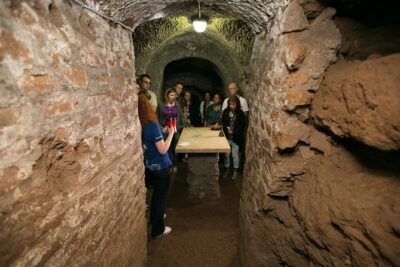
The Original Roman Crypts and Catacombs Tour with Transfers
Read the review →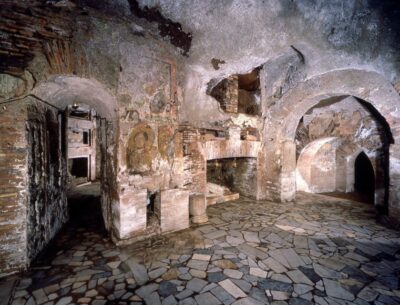
Catacombs of St. Callixtus Entry Ticket & Guided Tour
Read the review →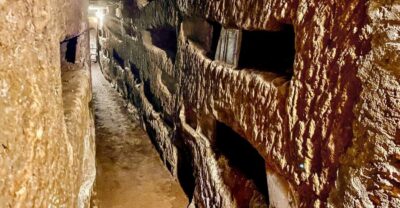
Rome EBike Tour: Appian Way, Catacombs & Roman Aqueducts
Read the review →